


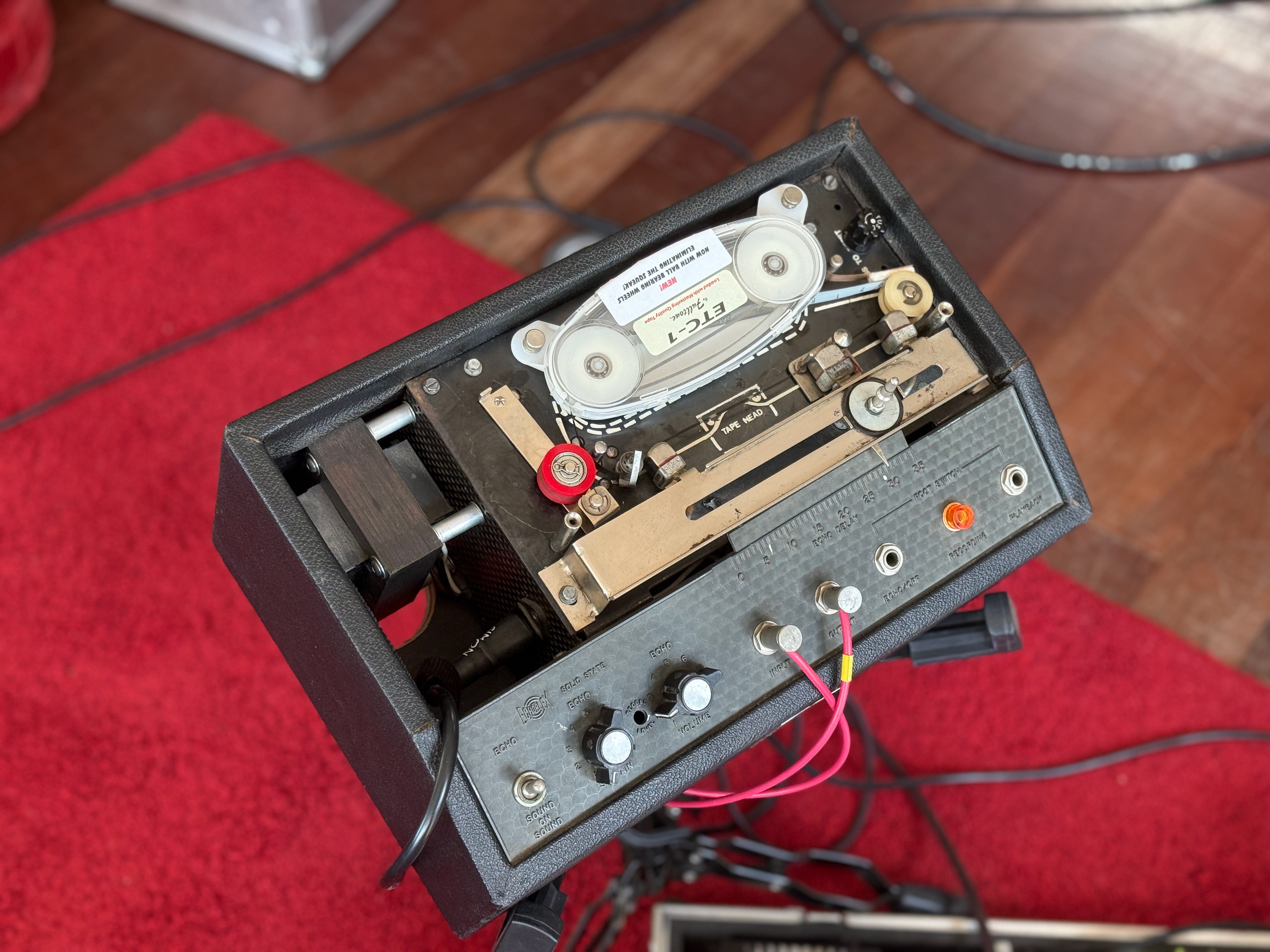
It’s been a while since I wrote a technical article, but last week my trusty Maestro Echoplex EP-3 needed some TLC, which inspired this piece.
First, a note for our readers.
We post on a variety of topics, and understand that you may only want to see certain categories of posts. To accommodate this, we have created sections where you can choose what you receive from us. Click below to read our article from 2024 on how to do this!

OK, now onto the business of this article.
It’s all about tape.
I have been using tape echo units since the very beginning of my music career, kicking off in 1976 with the then ubiquitous Watkins Copycat, but soon graduated to an HH Electronic ’slider’ unit, which I used for many years until it was left on the curb following a Whitefire gig at The Derby Hall (now The Met) in Bury, England.
Following a dalliance with a Roland Space Echo RE-201, my next unit was the Maestro Echoplex EP-3, which my hero Jimmy Page used extensively.
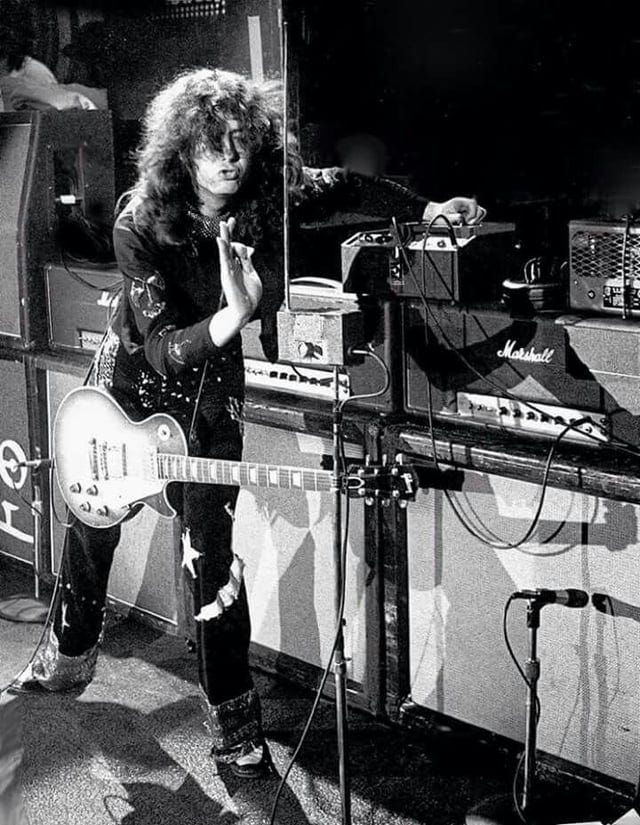
What is an Echoplex?
The Echoplex is a tape delay effects unit, first made in 1959. Designed by engineer Mike Battle, it set a standard for the effect in the 1960s, and it is still regarded as the benchmark by which everything else is measured. The Echoplex was widely used in the 1960s and 1970s, mainly by guitarists but also by other performers.
Background
Tape echoes work by recording sound onto a magnetic tape, which is then played back; the tape speed and distance between the recording and playback heads determine the delay time, while a feedback variable (where the delayed sound is fed back into the input) allows for multiple echoes.
EP-2
The first valve/tube Echoplex units had no numerical designation, but this model was retroactively designated the EP-1 after the first revision was dubbed the EP-2. These two units were noted for their warm, round, thick echo and the sound quality of the valve/tube preamplifier section. Two of Battle’s improvements over earlier designs were key: the adjustable tape head and a cartridge containing the tape, protecting it to retain sound quality.
EP-3
Market Electronics, who originally manufactured the Echoplex, held off on using transistors while other companies made the transition. Nevertheless, in the late 1960s, they set Battle and Dixon to the task of creating the first transistorised Echoplexes.
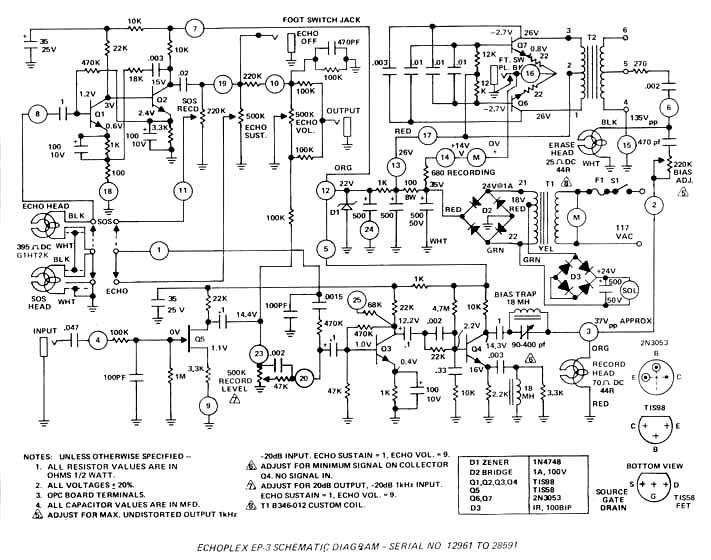
Once the two were satisfied, the solid-state Echoplex was offered by Maestro beginning in 1970 and designated the EP-3, which offered a sound-on-sound mode plus a number of minor improvements.
The EP-3 enjoyed the longest production run of all the Echoplex models, being manufactured until 1991. Around the time of the public introduction of the EP-3, Maestro was taken over by Norlin Industries, then the parent company of Gibson.
Our EP-3
Over the years, I have bought and sold many of these units: the latest being bought from a friend in the UK. It was originally a 120V version with a separate transformer. We decided to fit an internal unit to step down the voltage from 240V to 120V, and after consulting with the wonderful Luke Horlick of T4Transformers—based in Margate, England—we fitted one of his transformers with the expert assistance of my guitar tech and great friend from the Isle of Man, Dave Swindells.


It’s unusual.
I use old-school amps with no master volume and like the sound of a guitar amp’s output section pushed into breakup, which presents a serious problem when using time-based effects.
When delays, reverbs, or modulation effects are run into the front of a distorting amp, the saturation smears the repeats and textures, often resulting in a muddy or cluttered sound.
Being a studio musician for more years than I care to think about really changes the way you feel about this, as I almost always use these effects post-recording in the mix.
It’s a struggle that clean-tone icons like Johnny Marr or Dumble clone players—and who the fuck can afford an original—avoid entirely; by using effects loops for time-based effects or pedals for distortion, they keep their echoes pristine and separated by not overdriving the output valves/tubes.

Over the years, I have developed a unique approach to creating my live guitar sound, which is unconventional, and I share this concept with a few players, notably Larry Carlton. I am going to write another article about how I deal with this issue, so watch out for it!
If you find value in these posts, the best way to support our work is to subscribe. We’ve made sure everything stays open to all, but choosing a paid subscription provides the vital support we need to remain independent. It’s a small gesture—about the price of a coffee—that has a massive impact on our ability to keep creating. We’re so grateful to have you with us, regardless of how you choose to subscribe.
Alternatively, you can…
Pedals.
Even though we have piles of pedals, I rarely use them when recording and mainly use them playing live when trying to recreate the sounds from our records with limited amps, et al. Of course, there are exceptions to every rule, and the Echoplex is one of them. For me, it’s an always-on effect.
Yes, when you push the power stage of the amp into distortion, the echo from the Echoplex seems to be compressed into the guitar sound, but blooms when the note dies away as the power valves/tubes come out of clipping; very much like an analogue version of the ‘duck delay’ setting on our vintage TC Electronic 2290. It’s pleasing, and I can live with it—in fact, I can’t live without it.
There is also nothing like the sound when you push the level and feedback to maximum and frantically jiggle the bar which governs the delay time: total uncontrolled bedlam.
The magic.
There are two distinct benefits for using a tape echo: the preamp and the sound of the tape delay.
Eric Johnson is a devotee of the Echoplex, but due to reliability issues uses the preamp section, sending the output into a digital delay. Some do a similar trick but using a solid-state, bucket brigade analogue delay.
Among Johnson's secret tone weapons are a pair of Echoplexes modded by Bill Webb of Austin Vintage Guitars. Webb has removed the tape loop and bypassed it to allow Johnson to use other effects, including a Catalinbread Belle Epoch Tape Delay and MXR Digital Time Delays, in place of tape and still get the sweetening the devices' preamps deliver.
This is cool, but you do lose the wow and flutter of the tape passing the heads, which is caused by a fucked tape, worn record/play/erase heads or dirty pinch roller—and let’s face it, nobody wants a dirty pinch roller…
On its own, these ‘imperfections’ sound very funky, but when mixed with the original signal, it creates a chorus-type effect with random detune. It’s unpredictable, and that’s the joy.
I have used it—and will again—on our recordings. Stick vocals, guitars, drums—basically anything—in an aux send on the board, then return it to a channel and boomaroono!
We are Radial Engineering artists, and here is an unashamed plug. If you want to use unbalanced guitar/bass effects in your studio or rig, you must have the EXTC stereo guitar effects interface, which also doubles as a reamper.


Emulations.
There are literally hundreds of pedals that claim to replicate the whole sound, and some that only emulate the preamp section. Apart from the Catalinbread Epoch Boost, which is championed by Radiohead’s Ed O’Brien, I have tried the best-reviewed ones, but found them sadly lacking.
The one that I believe sounds closest to our Echoplex preamp is the ChaseTone secret preamp, which I have owned for many years. Kyle Chase has done a splendid job in recreating the circuit, but even though it’s good, it still doesn’t sound like mine. Why is that?
It’s all about tempering.
Any bit of analogue gear has been switched on, off, heated and cooled thousands of times, hence the components drift out of value, and therefore each one sounds different.
This is the issue I have with pedals and plugins. They may sound like the ones they have modelled, but they don’t sound like ours.
I have had many a heated discussion about this, generally with people who have never even seen an original, never mind used one in anger. It’s the same with compressors and other rack-mount studio gear. “Oh, this Urie 1176 plugin sounds just like an original”.
Every fucker seems to manufacture a digital emulation. Strymon attempt it in the Timeline and El Capistan, but having owned both, they just don’t sound the same. Pedals can be great, but with the notable exception of the OTO Machines BIM—which makes a great job of replicating the Lexicon Primetime (although with a uniquely French counterintuitive designed user interface), emulations and copies are mostly arse.
Vibe.
In isolation, they sound OK, until you compare them with an original, record them or use them in a live set, IMHO, lacklustre nonsense.
It’s not just the sound. It’s the physical connection you get with a vintage item that makes you feel different, and creativity is all about feel.
Watch Daniel Lanois work with his Lexicon Prime time, and you will see what I mean.
This seems harsh, and thousands of world-class players will disagree with me, but I can hear and feel the difference.
Digital.
A little digression here, as we do use alternative delay units both live and in the studio.
We have in our studio, the Supertone SonicLab, an OTO Machines BIM, vintage TC Electronic 2290, Eventide Eclipse, H3000 and H90, Line 6 DL4 MkII (on Suzy Starlite’s live board) and a most excellent Meris LVX.
Talking of Starlite, she writes for Bass Musician Magazine and has done a great series on her bass journey, featuring all her gear. It’s called Walking The Bass Line and is worth a read if you have the time.
In my live rig, I currently use the H90, BIM and LVX in a wet-dry-wet configuration, but as I mentioned earlier, that’s for another article.
Tape echo reproductions.
I would be remiss not to include modern reproductions of the tape echoes.
Echofix EF-X3R Chorus Echo
We own a rack-mount version of this superb device. It’s an accurate clone of the original Roland Space Echo RE-501 Chorus Echo. The chorus effect is to die for and has a few really cool features which represent a genuine improvement over the original, such as the automatic turning off of the motor when not being used, thereby saving tape and head wear, plus individual outputs for all the tape heads.
Fultone TTE (Tube Tape Echo) / SSTE
Sadly, these models are no longer produced as recently Fultone was bought out and they have not reappeared in the product line, probably as they were very expensive to make and known to be temperamental.
We are still looking for a valve/tube version to add to our collection, or even better, find a reasonably priced EP-2 original.
Maintenance.


Maintaining these buggers is tricky, and I have to say, on a long tour, I would certainly take two.
Regular cleaning of the tape heads, pinch roller and replacing the tape is essential. I use Isopropyl alcohol on the heads, making sure it’s totally dry before rethreading the tape. I remove the roller by taking off the surclip with long-nosed pliers, then sliding it off. We have a special pinch roller cleaner which doesn’t dry out the rubber and ensures all the tape deposit is removed before replacing. A drop of light sewing machine oil on the spindle (the same stuff we use on our Hammond M100 organ tonewheel spindle) and off you go.
Degaussing.
Degaussing is not a form of sexual experimentation, but a process of demagnetising the heads, which I do every few months. This is common in regular maintenance of multitrack tape machines, but you have to be very careful, as improper use can be disastrous.
It’s all about the tape.
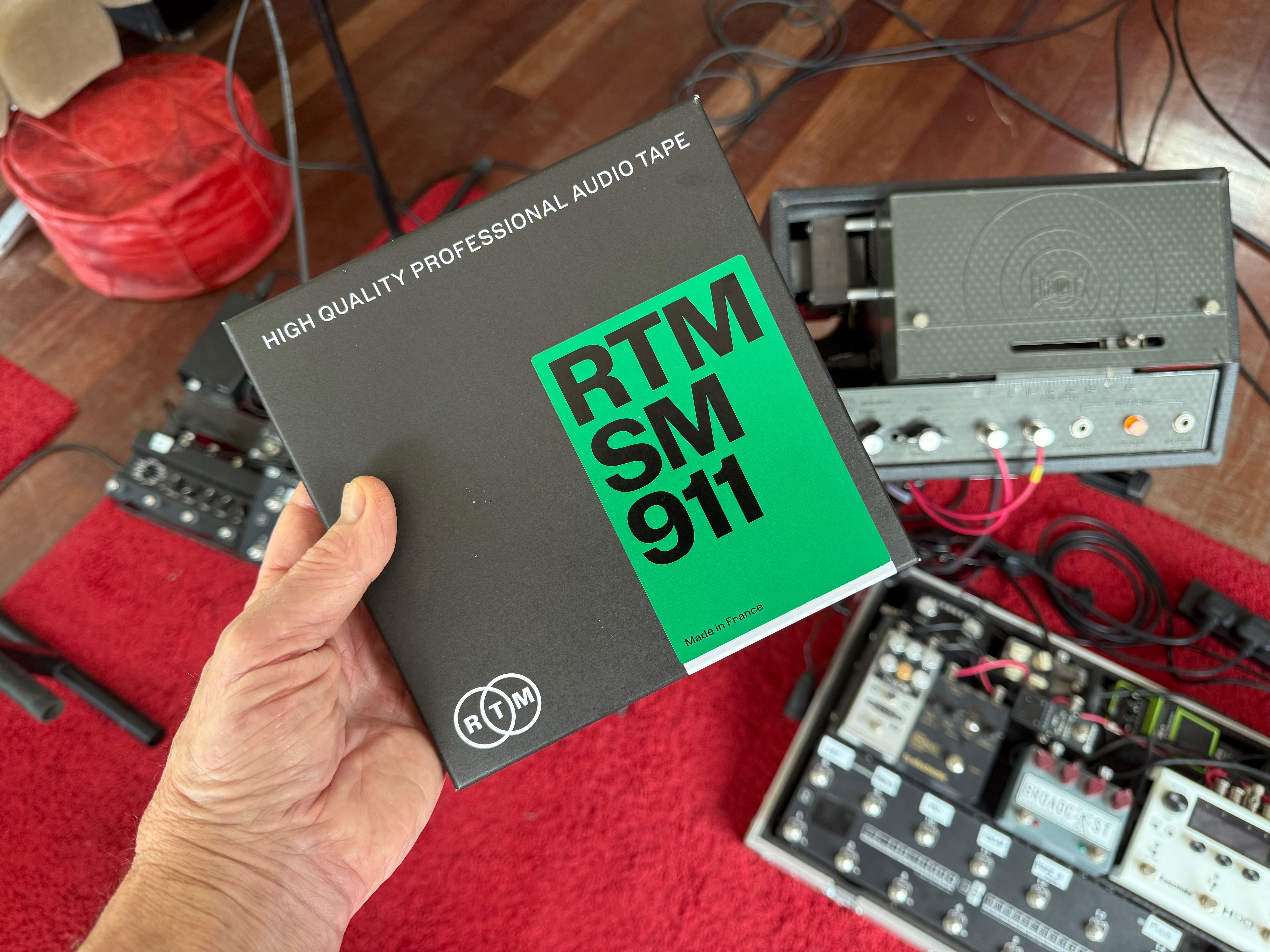
EchoFix sells replacement bits, including the precut to length tapes, but the cartridges are trickier to obtain, and the EC-1, which also fits the Fultone TTE/SSTE, are available from Soundgas in the UK.
We have a lot of experience with tape editing and bought a reel of 1/4” from the beautiful people at RTM, who are based in France. It’s much cheaper to buy it this way and takes about an hour to replace and reload each cartridge.
So is it worth the grief?
In a world of digital convenience, wrestling with vintage-style delays and cranked amps can feel like an uphill battle. We don’t use this gear because it’s easy; we use it because it has a character that nothing else can replicate.
Ultimately, great music is about more than just ‘correct’ audio; it’s about the feeling that a perfectly saturated tape delay or a cranked valve amp inspires in the player. That emotion translates directly to the performance.
So, for the sake of the music: yes, yes, yes—it is absolutely worth the grief.
See you next time.
Much love
Simon